Sustainability and fabrics, measured not promised
The Sustainability and Fabrics document sets out how ZER0 evidences a claim rather than makes one. Recovered cotton and recycled polyester processed back to fibre, an eight step chain from fibre recycling through to finished garment, third party life cycle figures, four fabric families, and eleven marks held across the partner base.
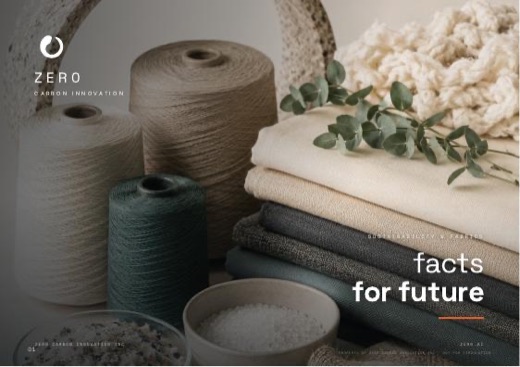
how the fibre works
Recovered cotton begins as textile waste, not as new ground. It is sorted by colour, shredded back to fibre and re-spun, which is why the yarn carries its colour without being dyed again. Colour is retained or engineered at fibre, so there is no wet dyeing stage. The fibre is GRS certified and traceable from recovered material to finished garment.
eight steps, one accountable chain
Material runs from 01 to 04 and product from 05 to 08: fibre recycling, fibre mixing, tracer, yarn spinning, then fabric manufacturing, apparel manufacturing, technical finishes and business activity. DNA tracer particles give the fibre a unique fingerprint. Technical finishes cover anti-odor, antibacterial, thermoregulation and UV protection as required.
what the life cycle assessment says
Recycled cotton against the conventional equivalent, per kilogram of finished clothing, in a Green Story life cycle assessment dated 2021: 99% less blue water, 96% less GHG and up to 76% less energy. Recycled polyester on the same basis: 92% less blue water, 94% less GHG and 80% less energy.
The document is explicit about the limit on all of it. When a number cannot be verified, ZER0 does not publish it, and circularity only counts when recovered fibre returns as commercially viable product.
four fabric families
Knits: single jersey, pique, rib, interlock, jacquard and terry, in cotton, poly, viscose, modal, linen, hemp and bamboo. Wovens: poplin, twill, denim and satin, across shirting, bottoms and outerwear weights. Natural dyes: plant derived and low impact dye routes developed in India, with the water and effluent record to match. Recycled: GRS certified recycled cotton and polyester, traceable from recovered fibre to finished garment.
the marks, and what they are not
Eleven marks in three groups, and the document separates them carefully. Certifications, awarded against a standard and audited to keep it: GOTS, OEKO-TEX Standard 100, WRAP and Better Cotton. Audit programmes, where a facility was assessed against a code rather than certified: amfori BSCI, Sedex SMETA, Higg, ICS and SLCP. Authorisations and the building itself: Disney FAMA and IGBC.
A mark appears only while it is current. Certificates go out on request under NDA, never as scans on a public page.
questions this document answers
- What certifications does ZER0 work with?
- Eleven marks across the partner base in three groups: certifications (GOTS, OEKO-TEX Standard 100, WRAP, Better Cotton), audit programmes (amfori BSCI, Sedex SMETA, Higg, ICS, SLCP) and authorisations (Disney FAMA, IGBC). A mark appears only while current, and certificates go out on request under NDA.
- How is recycled cotton coloured without dyeing?
- Recovered cotton is sorted by colour before it is shredded back to fibre and re-spun, so colour is retained or engineered at fibre and the programme runs without a wet dyeing stage.
key facts
| Document | 18 pages, PDF |
|---|---|
| Fibre | Recovered cotton and recycled PET, GRS certified and traceable |
| Chain | Eight steps, fibre recycling through to business activity |
| Fabric families | Knits · Wovens · Natural dyes · Recycled |
| Marks held | 11, across certifications, audit programmes and authorisations |
| LCA source | Green Story life cycle assessment, 2021, per kg finished clothing |
| Annual record (partner base) | 5M+ PET bottles and 2,000+ tonnes of cotton waste recycled a year |
| Renewable energy (partner base) | 40+MW at source |
the document
Sustainability & Fabrics, 18 pages, PDF. Everything on this page is read out of it.
start with one programme
Tell us what you want to carry and the calendar you have to hit. We come back with a programme, not a pitch.